
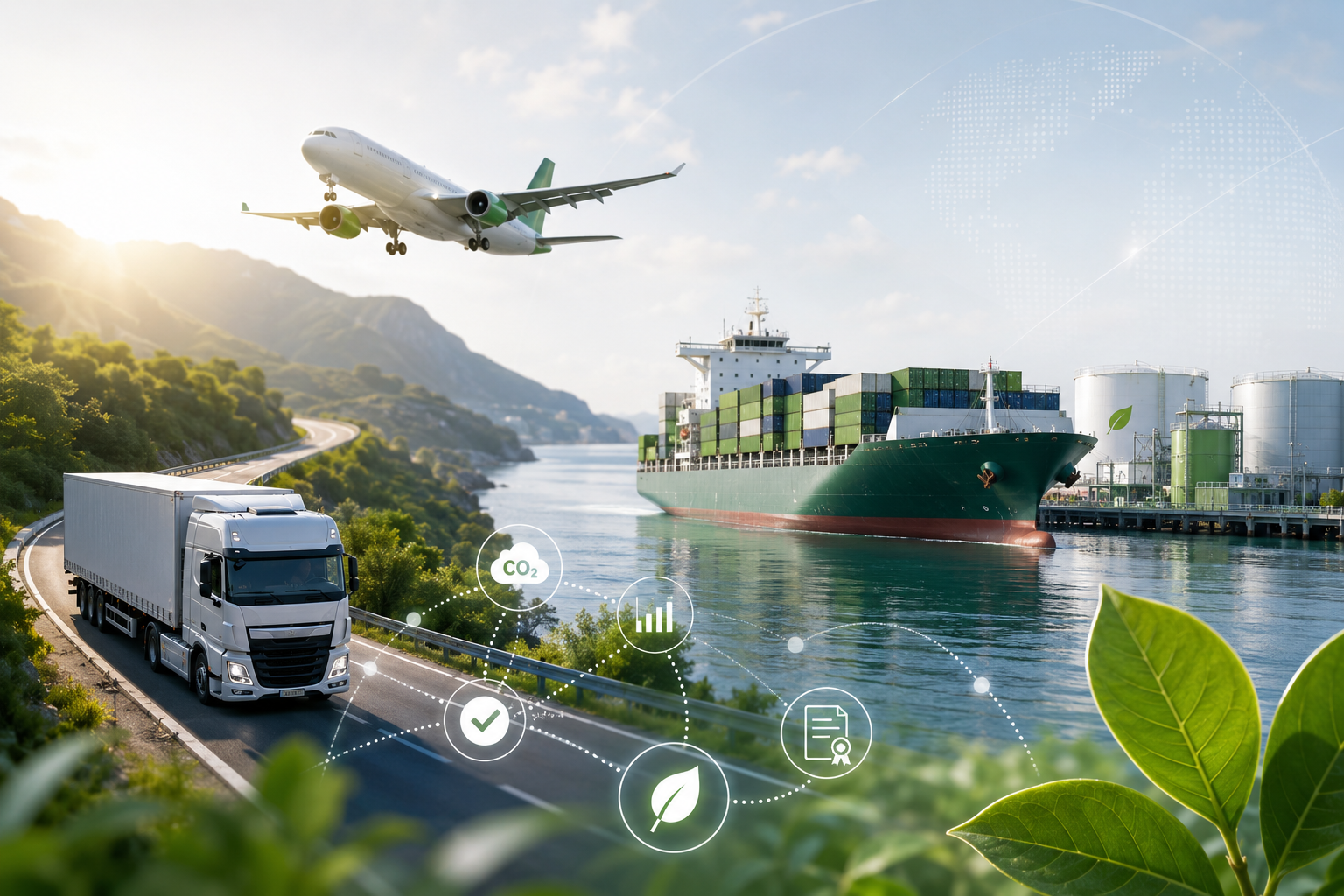
SBTi and Transport Emissions: What companies need to know
The release of the SBTi Corporate Net-Zero Standard Version 2.0 marks an important step forward for companies working to decarbonize transport, logistics and wider supply chains.
For many organisations, transport emissions are a major part of their Scope 3 footprint. They sit outside direct operations, but inside the value chain. That makes them difficult to reduce, measure and report on. The updated SBTi standard provides more clarity for companies that want to take credible climate action in these complex supply chains.
At FincoEnergies, we welcome this development. We have closely followed the development of the updated standard, contributed to consultation rounds and actively participated in industry working groups. The final release confirms something we have seen in the market for years: companies need practical, transparent and scalable ways to reduce transport-related emissions today.
What is the SBTi Corporate Net-Zero Standard Version 2.0?
The SBTi Corporate Net-Zero Standard Version 2.0 is the latest version of the Science Based Targets initiative’s framework for corporate climate action. SBTi describes Version 2.0 as its most comprehensive framework for corporate climate action to date, designed to support the shift from ambition to real-world implementation.
That shift matters. Many companies have already set climate targets, but the next challenge is delivery. Reducing emissions across operations, value chains and capital allocation requires clear guidance, credible tools and practical implementation routes. SBTi states that Version 2.0 is designed to embed science-based targets into core decision-making across operations, value chains and capital allocation.
For companies with transport and logistics emissions, this is an important signal. Climate targets are no longer just about reporting ambition. They are about showing measurable progress in the places where emissions actually occur.
Why does the SBTi update matter for transport emissions?
Transport and logistics are hard to decarbonize at scale. Goods move across global networks, often involving multiple carriers, freight forwarders, fuel suppliers, terminals and transport modes. Companies may be responsible for the emissions in their value chain, while having limited direct control over the physical fuel used in every shipment.
That is why Scope 3 transport emissions are such a challenge. They are often material, but they are also operationally complex. The updated SBTi standard responds to this reality by placing more emphasis on value chain action, implementation and the use of available decarbonization levers.
SBTi’s main changes document states that the revision of the Corporate Net-Zero Standard was intended, among other things, to enhance SBTi’s approach to addressing value chain, or Scope 3, emissions and improve interoperability with other relevant standards and frameworks.
For transport, this creates a stronger foundation for action. Companies can look beyond emissions measurement alone and start focusing on credible ways to support actual reductions in the transport sector.
What does SBTi say about market-based instruments?
One of the most important developments in the updated standard is the clearer recognition of market-based instruments as part of the corporate decarbonization toolkit. For companies working on transport and logistics emissions, this provides greater clarity and confidence.
The Corporate Net-Zero Standard Version 2.0 acknowledges the need for companies to use available levers for decarbonization and is designed to be interoperable with developing frameworks for carbon accounting and market instruments.
This matters because many companies cannot physically access sustainable fuels in every part of their transport chain. Sustainable fuels may be available in one geography, transport mode or route, while the company’s emissions occur across a much broader network. Market-based instruments can help bridge that gap, as long as they are used with strong integrity principles, clear documentation and transparent claims.

How does Book & Claim support supply chain decarbonization?
Book & Claim is a practical mechanism for decarbonizing transport when a direct physical link between the buyer and the sustainable fuel use is not possible or not efficient.
In a Book & Claim system, sustainable fuel is used somewhere in the transport system where it can create real emissions reductions. The environmental benefit of that fuel use is then recorded, allocated and retired through a controlled methodology. This allows companies to support sustainable fuel adoption and claim the associated CO₂e reduction, without requiring the sustainable fuel to be physically used in their own shipment.
For transport and logistics, this is essential. Global supply chains are complex, and fuel supply does not always follow the same path as cargo ownership or freight responsibility. Book & Claim creates a scalable way to connect demand for lower-emission transport with actual sustainable fuel use.
It gives companies a practical route to reduce Scope 3 transport emissions while helping the broader market for sustainable fuels grow.
What is transport insetting and why is it relevant to SBTi?
Transport insetting means reducing emissions within the transport value chain itself, rather than compensating for emissions outside the sector. For cargo owners, freight forwarders and companies with logistics emissions, this is an important distinction.
Instead of buying unrelated carbon credits, transport insetting supports real decarbonization in the transport system. In the case of Decarb Desk, the CO₂e reductions are always generated through the use of sustainable biofuels in marine, road, aviation and inland barging.
This aligns with the direction of the SBTi update: stronger focus on real-world implementation, supply chain action and credible decarbonization levers. The opportunity is not only to calculate emissions, but to reduce them through solutions that are connected to the transport sector itself.
How FincoEnergies supports SBTi-aligned transport decarbonization
FincoEnergies helps companies reduce transport and logistics emissions through solutions that make sustainable fuel use accessible, practical and scalable.
GoodShipping, the Biofuel Swap and the Decarb Desk digital platform and registry all support a transparent Book & Claim approach. Together, these solutions make it possible for companies to reduce transport-related Scope 3 emissions through certified CO₂e reductions from sustainable biofuels.
Decarb Desk plays a central role in this. It records the creation, allocation and retirement of CO₂e reduction certificates in a digital registry. This helps ensure that reductions are traceable, claims are properly documented and double counting is prevented.
Each issuance is verified by an independent third party. This strengthens the credibility of the certificate and gives companies the documentation they need for reporting, customer questions and audit processes.

Why traceability and integrity are essential for Scope 3 claims
As more companies act on transport emissions, the quality of documentation becomes increasingly important. A credible Scope 3 claim needs more than a statement of intent. It requires clear evidence of where the reduction came from, how it was calculated, who it was allocated to and when it was retired.
That is why Decarb Desk is built around a controlled digital registry. Every CO₂e reduction is created, allocated and retired within the system. Reductions are never created, traded or retired outside Decarb Desk.
The certificates include relevant information such as the sustainable biofuel used, fuel references and calculations, feedstock type, delivery location, transport modality, vessel type where relevant, and the GHG reduction percentage. This gives companies a clear and verifiable basis for Scope 3 reporting.
For freight forwarders and resellers, Decarb Desk can also be integrated via API. This allows CO₂e reductions to be allocated to end customers directly from existing systems, while every end customer receives a unique certificate.
What should companies do now?
The release of the SBTi Corporate Net-Zero Standard Version 2.0 gives companies more clarity, but the direction is already clear: transport emissions need credible, measurable and scalable action.
For companies with Scope 3 transport emissions, now is the time to understand where emissions sit in the value chain, identify the transport modes that matter most and explore how sustainable fuels, Book & Claim and transport insetting can support their climate targets.
SBTi notes that companies will be able to submit targets for validation under Version 2.0 from early 2027, while companies setting targets in 2026 are advised to use the current Corporate Net-Zero Standard Version 1.3.1.
But companies do not need to wait to act. Sustainable fuel solutions are available today. Book & Claim can help scale their adoption. Digital registries can make reductions traceable. And transport insetting can help companies move from climate ambition to practical Scope 3 progress.
The next phase of transport decarbonization
The SBTi Corporate Net-Zero Standard Version 2.0 is an important step for companies working to decarbonize transport and supply chains. It brings more clarity to a market that is moving quickly and gives further confidence to companies that want to take credible action today.
At FincoEnergies, our focus remains unchanged: making transport decarbonization accessible, practical and scalable. We will continue to contribute to industry discussions, support the development of best practices and work with customers and partners to accelerate the use of sustainable fuels across global transport chains.
The opportunity to create impact at scale is greater than ever. With the right systems, partnerships and methodologies, companies can reduce transport-related Scope 3 emissions in a way that is transparent, credible and ready for the future.
