How APIs scale transport decarbonisation across freight platforms
July 1st 2026, Transport decarbonisation is becoming a practical business requirement. Cargo owners want to reduce Scope 3 emissions. Freight forwarders want to offer credible lower emission services. Platforms want to help customers act without adding complexity to existing logistics workflows.
Yet one question often remains unclear: what exactly is being bought when a company purchases CO₂e reductions for transport?
That question matters. In the market, transport reductions are often described in vague terms. Customers may not know whether they are buying an offset, an inset, a certificate, a fuel switch or a reporting instrument. They may also struggle to understand whether the reduction is linked to real freight activity, whether it can be claimed once, and whether the evidence is strong enough for Scope 3 reporting.
Credibility comes first. Before transport decarbonization can scale across digital platforms, the reduction itself needs to be transparent, traceable and verifiable.
That is the role of Decarb Desk® by FincoEnergies. Decarb Desk® is a digital book & claim registry and API gateway for verified transport decarbonization. It helps organisations calculate transport emissions where needed, choose a transport modality, order lower emission solutions, allocate CO₂e reductions and receive verified customer certificates with traceability data.
Decarb Desk has been shortlisted for the World Sustainability Awards 2026 in the Digital Provider Award category, recognising its role in making transport decarbonization more accessible, scalable and verifiable.
Why credible CO₂e reductions matter in transport decarbonisation
Transport decarbonisation only creates value when the claim is clear. Cargo owners, platforms and logistics partners need to know what activity created the reduction, how it was calculated, how it was allocated and how double claiming is prevented.
This is especially important for Scope 3 transport emissions. Cargo owners often do not own the truck, vessel, aircraft or barge that moves their goods. They rely on carriers, freight forwarders, parcel networks, fuel providers and digital platforms. That creates distance between the company making the climate claim and the physical activity that reduces emissions.
Decarb Desk® helps close that gap. The platform creates a digital record of CO₂e reduction certificates from generation to allocation and retirement. This makes it possible to connect lower emission transport activity to a verified customer certificate in a transparent and auditable way.
A credible transport reduction should answer these questions:
- What lower emission transport activity created the reduction?
- Which transport modality does it relate to?
- Which methodology was used?
- How is the reduction allocated?
- How is double claiming prevented?
- What certificate and traceability data support the claim?
- How can the customer use the reduction for Scope 3 reporting?
For platforms, these answers are essential. They turn decarbonization from a vague add on into a trustworthy service.
How Decarb Desk® aligns with Smart Freight Centre’s MBM framework
Decarb Desk® is built around a digital book & claim methodology developed with reference to the Smart Freight Centre’s Market Based Measures Framework.
The Smart Freight Centre framework supports the use of market based accounting approaches in logistics emissions reporting, including flexible chain of custody models such as book & claim. These approaches help accelerate the uptake of lower emission transport solutions in complex freight networks, where the customer who pays for the reduction may not be physically linked to the exact vehicle, vessel, aircraft or barge using the lower emission fuel.
This matters because global transport systems are interconnected. A cargo owner may want to reduce Scope 3 transport emissions, but may not control the fuel used on a specific journey. Infrastructure availability also differs by region and modality. Book & claim helps solve this by allowing lower emission transport services to be generated, registered and claimed in a structured way.
Decarb Desk applies this logic through a digital registry. CO₂e reductions are created from real sustainable biofuel use in transport, then allocated to customers through verified certificates. This supports transparency, traceability and reporting readiness.
Why carbon insetting is different from offsetting
Carbon insetting and offsetting are often confused. They should not be. Offsetting usually compensates for emissions by financing climate projects outside the company’s own value chain. Insetting focuses on reducing emissions within or close to the value chain where the emissions occur.
For transport, that distinction is important. Decarb Desk® supports reductions that come from the use of sustainable biofuels in freight transport. These fuels replace fossil fuels in real transport operations across modalities such as sea shipping, road transport, aviation and inland waterway transport.
Sustainable biofuels based on waste and residue streams form the foundation for cleaner, lower emission freight transport. Depending on the fuel pathway and transport modality, these biofuels can deliver around 85% less CO₂e on average compared with conventional fossil fuels. That means companies are not simply compensating elsewhere. They are helping to accelerate a real fuel switch within the transport sector.
Through Decarb Desk®, that fuel switch becomes digitally traceable. The reduction is registered, allocated and documented with a verified customer certificate.
What is a book & claim API for transport emissions?
A book & claim API for transport emissions allows digital platforms to connect directly with Decarb Desk. Instead of asking users to manage decarbonization through separate emails, spreadsheets or portals, platforms can integrate verified CO₂e reductions into their own workflows.
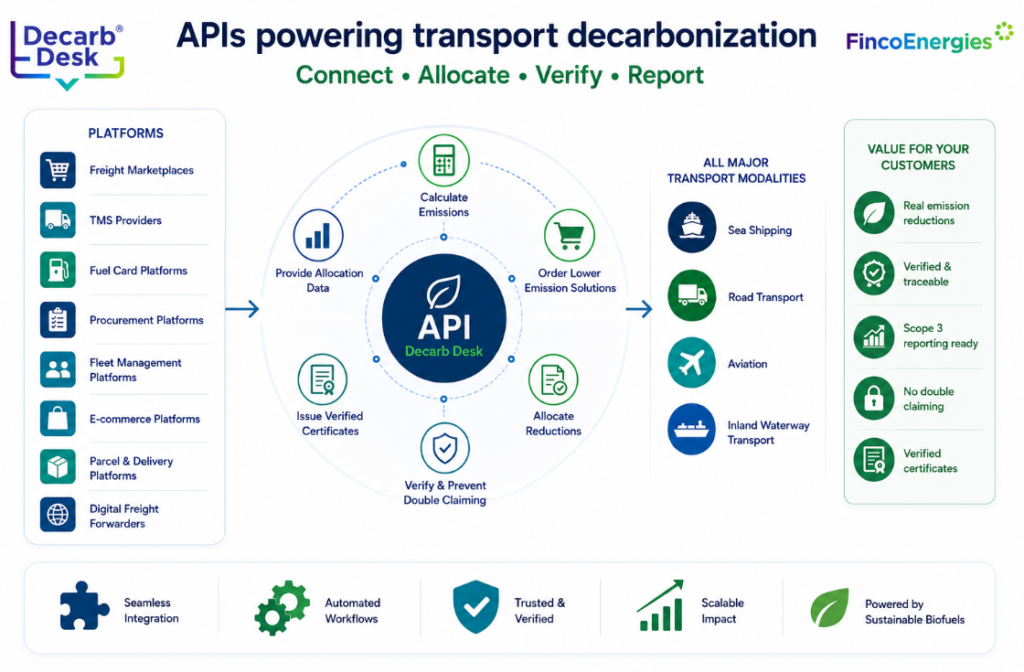
Through the Decarb Desk API, platforms can support key steps such as:
- Letting a customer choose a transport modality
- Calculating transport emissions on trade lane level
- Placing orders for lower emission transport solutions
- Allocating CO₂e reduction certificates to end customers
- Receiving verified customer certificates with traceability information
- Retrieving allocation data for reporting and customer documentation
This creates a digital service layer for transport decarbonization. The platform keeps its own customer interface, while Decarb Desk provides the infrastructure for book & claim, allocation, certificates and verification.
How APIs make transport decarbonisation scalable
Freight is fragmented by nature. A single supply chain can involve cargo owners, freight forwarders, carriers, parcel providers, fuel suppliers, subcontractors and multiple digital systems.
Manual decarbonisation processes do not scale well in that environment. Every separate request, spreadsheet and certificate creates extra work. Every disconnected workflow slows adoption.
APIs make verified reductions available where transport decisions already happen. That can be at the moment of booking, at trade lane level, or as part of a reporting module where companies aggregate data quarterly or yearly.
Both use cases matter.
At trade lane level, a customer can choose a lower emission option when planning or booking transport. This helps make decarbonization part of operational decision making.
At reporting level, a company can cluster transport data over a period and allocate reductions across a larger footprint. This is often more efficient for companies with high shipment volumes, because it reduces the number of separate certificates needed and keeps reporting manageable.
The API supports both models. It helps platforms offer decarbonization as a flexible feature, not a one size fits all process.
API use case for freight marketplace platforms
Freight marketplaces connect cargo owners with transport capacity. They influence how freight is selected, priced and booked. That makes them a natural place to offer verified CO₂e reductions.
A freight marketplace can use the Decarb Desk API to give customers access to lower emission transport solutions during the booking process or through a periodic reporting module. The platform can connect reduction options to specific trade lanes, customers or reporting periods.
Relevant use cases include:
- Offering lower emission options during freight booking
- Allocating verified CO₂e reductions by trade lane
- Providing certificates to cargo owners
- Supporting quarterly or yearly reporting modules
- Helping logistics providers offer credible insetting services
For freight marketplaces, the API turns decarbonization into a platform feature that cargo owners can understand and trust.
API use case for transport management systems
Transport management systems sit at the centre of logistics operations. They manage routing, shipment execution, carrier selection, cost control and reporting. That makes them an ideal environment for connecting emissions data with reduction actions.
With the Decarb Desk API, a TMS can calculate emissions where needed, connect transport flows to reduction options and allocate certificates to the right customer, trade lane, business unit or reporting period.
Relevant use cases include:
- Calculating emissions per movement, lane or modality
- Offering verified reductions during planning or reporting
- Allocating certificates to specific customers or business units
- Supporting quarterly and yearly Scope 3 reporting
- Helping cargo owners move from emissions visibility to emissions reduction
For TMS providers, the API helps turn transport emissions data into practical decarbonization action.
API use case for fuel card and mobility card platforms
Fuel card and mobility card platforms already sit close to energy transactions. They help transport companies manage fuel access, payments and mobility spend. That gives them a powerful role in making sustainable biofuel solutions easier to adopt.
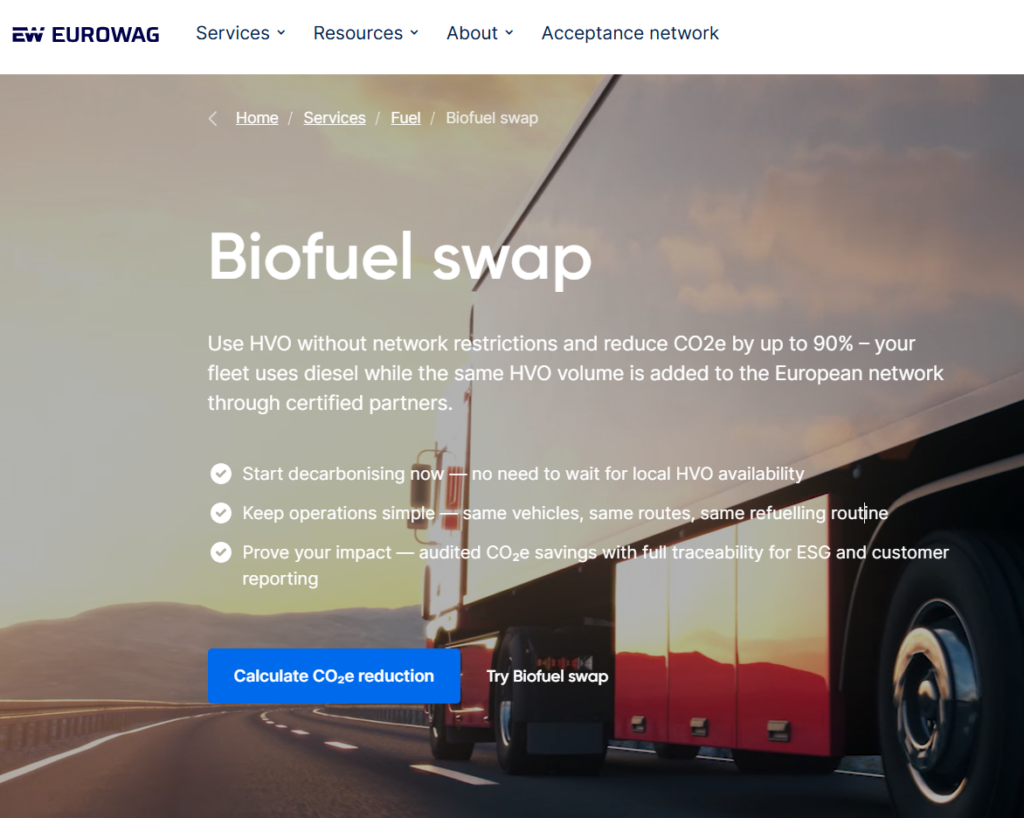
FincoEnergies’ collaboration with Eurowag shows how this can work in practice. Through the Decarb Desk API, Biofuel Swap is made available across a network of more than 300,000 trucks in Europe. Transport companies can switch to sustainable biofuels through a digital platform, without changing vehicles, routes or infrastructure.
Relevant use cases include:
- Offering sustainable biofuel conversion in existing fuel workflows
- Linking fuel related activity to verified CO₂e reductions
- Issuing verified customer certificates with traceability data
- Helping carriers support cargo owner to reduce their Scope 3 transportation footprint
- Making lower emission road transport accessible at scale
For fuel card and mobility platforms, the API makes decarbonization available where energy decisions are already managed.
Eurowag example of API Implementation
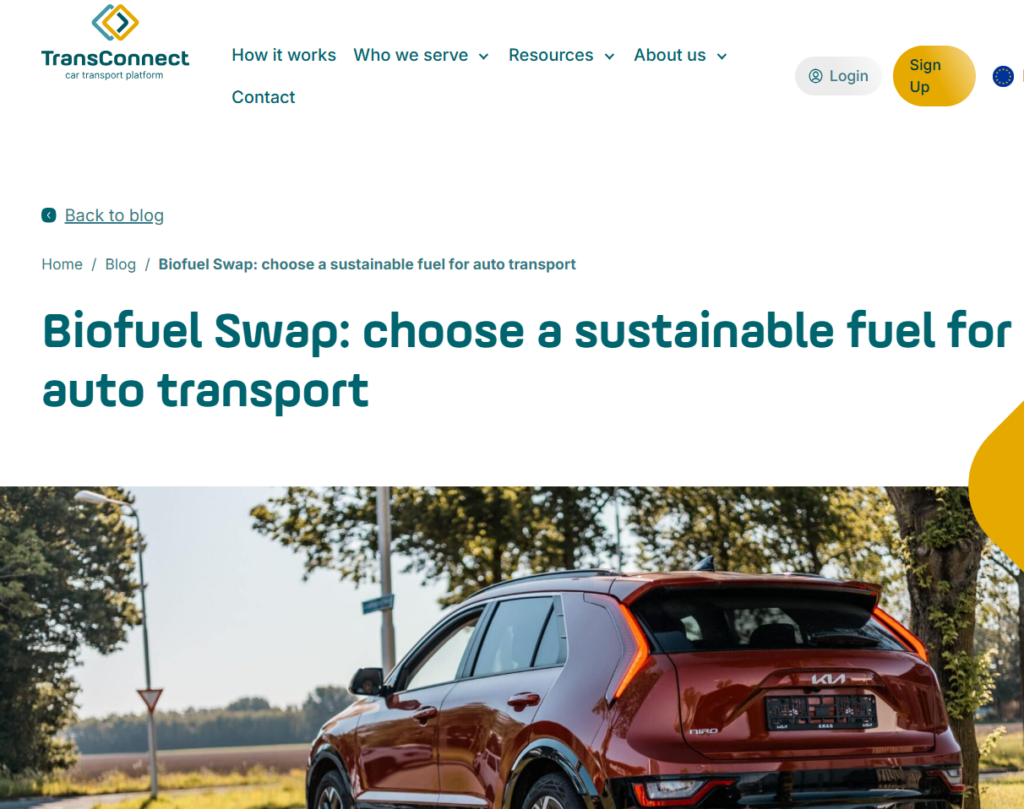
Transconnect example of API Implementation
API use case for procurement platforms
Transport procurement is increasingly shaped by emissions performance. Cargo owners want to compare logistics partners not only on price, capacity and service quality, but also on their ability to support measurable CO₂e reduction.
A procurement platform can use the Decarb Desk API to bring verified reduction options into sourcing events, tender evaluations and supplier discussions. This helps procurement teams move from sustainability commitments to practical reduction pathways.
Relevant use cases include:
- Adding CO₂e reduction options to transport tenders
- Comparing lanes or suppliers by reduction availability
- Allocating reductions to awarded lanes or contracts
- Supporting supplier engagement with verified certificates
- Giving procurement teams evidence for internal sustainability reporting
For procurement platforms, the API helps make sustainability a measurable part of buying transport.
API use case for fleet management platforms
Fleet management platforms help operators manage vehicles, routes, fuel use, driver performance and compliance. For fleets that want to reduce emissions without replacing vehicles immediately, sustainable biofuel solutions can create practical progress today.
Through Decarb Desk, lower emission transport solutions can be ordered, allocated and verified digitally. Fleet platforms can use the API to connect operational fleet activity with decarbonization actions and customer reporting.
Relevant use cases include:
- Connecting fleet operations to sustainable biofuel based reductions
- Allocating reductions to customers, depots or operating regions
- Supporting carrier sustainability reporting
- Providing certificate evidence for tenders
- Helping fleets contribute to cargo owner Scope 3 reduction targets
For fleet platforms, the API helps make decarbonization part of day to day fleet performance.
API use case for e-commerce platforms
E-commerce platforms shape how products are sold, fulfilled and delivered. Merchants and brands increasingly want clearer information about delivery emissions and credible options to reduce them.
A Decarb Desk API integration can help e-commerce platforms offer transport insetting at checkout, in merchant reporting or as part of fulfilment services. The platform can allocate reductions to merchants, product categories, delivery flows or reporting periods.
Relevant use cases include:
- Offering lower emission delivery contributions at checkout
- Helping merchants reduce logistics related Scope 3 emissions
- Allocating verified reductions to brands or sellers
- Providing certificates for sustainability reporting
- Making delivery decarbonization easier for merchants to access
For e-commerce platforms, the API turns transport decarbonization into a simple, embedded option.
API use case for parcel and delivery management platforms
Parcel and delivery management platforms connect merchants, carriers and end customers across complex distribution networks. They often manage high shipment volumes, multiple carriers and many delivery options. That makes automation essential.
With the Decarb Desk API, these platforms can support CO₂e reduction across parcel flows and allocate verified certificates to merchants or customers. This can happen at shipment level, but it can also happen through aggregated quarterly or yearly reporting modules.
Relevant use cases include:
- Supporting emissions reduction across parcel flows
- Aggregating reductions across high volume shipment data
- Allocating CO₂e reductions to merchants or customers
- Adding certificate data to delivery reports
- Supporting credible lower emission delivery propositions
For parcel platforms, the API makes verified transport reductions manageable at scale.
API use case for digital freight forwarders
Digital freight forwarders combine logistics expertise with technology. They manage multimodal shipments, customer portals, rate engines and reporting tools. Their customers increasingly expect emissions visibility and credible reduction options in the same digital environment.
Decarb Desk supports transport insetting across major modalities, including sea shipping, road transport, aviation and inland waterway transport. That makes the API relevant for digital freight forwarders that manage complex, multimodal supply chains.
Relevant use cases include:
- Offering insetting options for sea, road, air and inland waterway transport
- Allocating reductions to customers, trade lanes or reporting periods
- Integrating verified certificates into customer documentation
- Supporting multimodal Scope 3 reporting
- Helping cargo owners act on hard to reduce freight emissions
Examples in practice:
Several digital freight forwarders are already embedding lower-emission transport solutions into their customer offering. For example, Rotra offers customers the option to reduce ocean freight emissions through certified Biofuel and verified customer certificates as part of its digital logistics services. Similarly, Flexport has highlighted its partnership with GoodShipping to help customers reduce maritime emissions through sustainable marine biofuels, making lower-emission shipping more accessible within its platform. These examples demonstrate how digital freight forwarders can integrate credible transport decarbonisation into the customer experience through scalable digital solutions.
- How Rotra enables Biofuel for sustainable ocean freight
- How Flexport supports maritime decarbonisation through marine biofuels
For digital freight forwarders, the API creates a scalable way to offer verified transport decarbonization as part of the customer experience.
What platforms can build with the Decarb Desk® API
The Decarb Desk® API gives platforms a practical way to add verified transport decarbonization to their own products and workflows.
Platforms can build features such as:
- CO₂e reduction options in booking flows, for all transport modalities
- Customer specific certificate allocation
- Allocation data for reporting modules
- Verified customer certificate delivery
- Reporting exports for Scope 3 disclosures
This means platforms can meet growing customer demand without building their own book & claim registry, methodology, certificate process or verification workflow from scratch.
How APIs support Scope 3 transport reporting
Scope 3 transport reporting depends on reliable data. Companies need to know which transport activities created emissions, which actions reduced them and which evidence supports the claim.
APIs improve reporting because they connect reduction data directly to the systems where transport data already lives. Instead of manually matching shipments, customer allocations and certificates, platforms can automate the flow of information.
This helps users answer the questions that matter for reporting:
- Which transport modality was selected?
- Which reduction was allocated?
- Which customer received the certificate?
- Which reporting period does it relate to?
- Which trade lane or transport flow does it support?
- Is the certificate verified and traceable?
For Scope 3 transport categories, especially Category 4 and Category 9, this structure is essential. It helps cargo owners report with more confidence and improve their approach year after year.
Why Decarb Desk® is built for platform integration
Decarb Desk® is offered both as a platform and as an API gateway. That flexibility matters because every organisation works differently.
Some companies want to manage their decarbonization activities directly in Decarb Desk. Others want to connect existing platforms, tools and systems. For digital platforms, the API creates a direct link between their own product and FincoEnergies’ decarbonization infrastructure.
Decarb Desk® enables platforms to:
- Choose the relevant transport modality
- Calculate transport emissions when needed
- Order lower emission transport solutions
- Allocate verified reduction certificates to end customers
- Receive verified customer certificates with traceability data
- Retrieve allocation data for reporting
That combination is what makes the model scalable. The physical reduction happens through sustainable biofuels. The digital allocation happens through Decarb Desk. The customer experience happens inside the platform the user already works with.
How APIs help turn transport decarbonisation into action
The next phase of transport decarbonisation will be built into everyday freight systems.
Freight marketplaces can offer lower emission options in booking flows. TMS providers can connect transport data with verified reductions. Fuel card platforms can make sustainable biofuel switching accessible. Procurement platforms can include CO₂e reduction in supplier selection. Fleet tools can link operations to certificates. E-commerce platforms can help merchants act on delivery emissions. Parcel platforms can manage reductions at volume. Digital freight forwarders can offer verified insetting across multimodal supply chains.
APIs make credible transport decarbonization accessible, repeatable and ready to scale. With Decarb Desk, FincoEnergies combines physical energy supply with digital infrastructure. The result is a practical route for platforms to help their customers reduce transport emissions, support Scope 3 reporting and accelerate the transition to cleaner freight.