
Book and Claim vs. Mass Balance: what is the difference?
Companies working to reduce transport emissions often come across two important chain-of-custody models: Book and Claim and Mass Balance. Both are used to connect sustainable fuel use with environmental claims, but they work in different ways.
The difference matters. For cargo owners, freight forwarders, and companies with Scope 3 transport emissions, the right model determines how CO₂e reductions are tracked, allocated and reported. It also determines how scalable a decarbonization solution can be across complex supply chains.
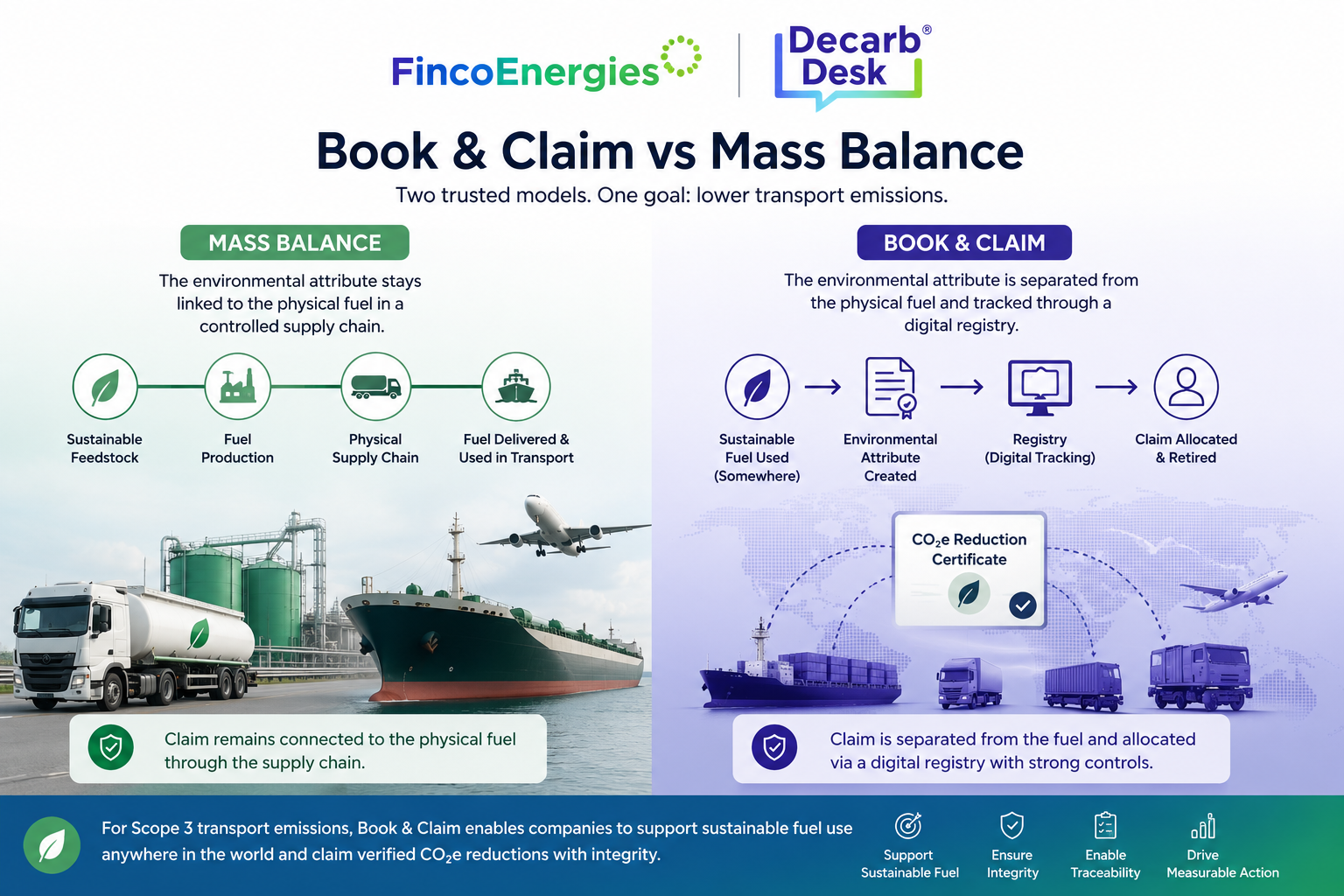
In short: Mass Balance keeps a link with the physical fuel supply chain. Book and Claim separates the environmental attribute from the physical fuel flow and records it in a registry. Both models can support credible climate action when they are used with strong documentation, clear rules and reliable verification.
What is a chain-of-custody model?
A chain-of-custody model explains how the sustainability characteristics of a product are tracked from production to use. In transport decarbonization, this is especially relevant for sustainable fuels.
The physical fuel may move through production sites, storage tanks, blending facilities, terminals, pipelines, vessels or vehicles. At the same time, companies need to know who can claim the environmental benefit linked to that fuel. Chain-of-custody models create the rules for that connection.
ISCC describes different chain-of-custody options as models that differ in the connection between the physical material and the sustainability characteristics of that material. Under Mass Balance, certified and non-certified material may be physically mixed, while the certified share is tracked separately through bookkeeping.
What is Mass Balance in sustainable fuels?
Mass Balance is a chain-of-custody model where sustainable and conventional materials can be physically mixed, while the sustainability characteristics are tracked administratively.
This means that the exact molecules of sustainable fuel do not need to be physically delivered to the final buyer. However, there must still be a controlled link to a defined physical supply chain. Certified material enters the system, volumes are tracked, and claims cannot exceed the certified volumes that were actually sourced.
In practical terms, Mass Balance works well when sustainable fuel is moving through a connected supply chain. It is commonly used in certification systems because the physical flow of material remains part of the accounting boundary. ISCC explains that under Mass Balance, no entity can claim more certified products than it sourced.
What is Book and Claim in transport decarbonisation?
Book and Claim is a chain-of-custody model where the environmental attribute is separated from the physical fuel flow.
In this model, sustainable fuel is used somewhere in the transport system where it can create real emissions reductions. The corresponding CO₂e reduction is then booked into a digital registry. A buyer can claim that reduction by purchasing and retiring the certificate, even if the sustainable fuel was not physically used in that buyer’s own shipment.
ISCC describes Book and Claim as a model where the sustainability attributes of sustainable aviation fuel are decoupled from the physical fuel and typically recorded and transferred through digital registries.
This makes Book and Claim especially relevant for transport and logistics. Sustainable fuels are not available everywhere, and companies often do not control the exact fuel used in every shipment. Book and Claim solves this by allowing companies to support sustainable fuel use where it is available, while allocating the verified reduction to their own Scope 3 transport footprint.
What is the main difference between Book & Claim and Mass Balance?
The main difference is the link between the physical fuel and the environmental claim.
With Mass Balance, the environmental attribute remains connected to a physical supply chain. Sustainable and conventional fuel can be mixed, but the certified volumes are tracked through the supply chain and claims are limited by the certified input.
With Book & Claim, the environmental attribute is decoupled from the physical fuel flow. The sustainable fuel is used in one place, while the CO₂e reduction certificate can be claimed by a buyer elsewhere, as long as the reduction is registered, allocated and retired correctly.
A simple way to look at it:
Mass Balance follows the fuel through the supply chain. Book and Claim follows the verified environmental attribute through a registry.
Why does Mass Balance keep a physical link?
Mass Balance keeps a physical link because the sustainability claim is tied to material that enters and moves through a controlled supply chain.
That does not mean the buyer receives the exact same molecules of sustainable fuel. In many fuel systems, molecules are mixed in tanks, pipelines and distribution networks. But the accounting still follows the physical supply chain. Certified input and certified output must balance.
This makes Mass Balance useful in regulated or certification-driven environments where the physical flow of material is central to the claim. It provides a strong structure for tracking sustainable fuel volumes through connected supply chains.
The limitation is reach. Mass Balance can only work where the certified supply chain exists and where all relevant actors can participate in the tracking system. For global transport networks, that can make it harder to scale quickly.
Why does Book & Claim separate the claim from the physical fuel?
Book and Claim separates the claim from the physical fuel because transport supply chains are global, fragmented and difficult to control.
A cargo owner may want to reduce Scope 3 emissions from ocean freight, road transport, air freight or inland barging, but may not be able to ensure that sustainable biofuel is physically used in its exact shipment. Sustainable fuel availability also differs by location, route and modality.
Book and Claim addresses this practical challenge. It allows sustainable fuel to be used where it is available and where it can reduce emissions immediately. The environmental benefit is then issued as a certificate and allocated to the buyer through a controlled registry.
This is why Book and Claim is often seen as a scalable model for hard-to-abate sectors. SEA-LNG describes Book and Claim as the most scalable and flexible chain-of-custody system because it can connect buyers and sellers globally.
Which model is better for Scope 3 transport emissions?
For Scope 3 transport emissions, Book and Claim is often the more practical and scalable option.
That is because many companies with Scope 3 transport emissions are not fuel buyers themselves. They are cargo owners, brands, retailers, manufacturers or freight forwarders. They may pay for transport, but they do not always control the fuel supply, the vehicle, the vessel, the aircraft or the route.
Mass Balance can work well when there is access to a connected certified supply chain. But for companies that need to reduce emissions across international transport networks, Book and Claim offers more flexibility. It enables them to support the use of sustainable fuels in the transport system and receive the corresponding CO₂e reduction certificate, without needing a physical fuel delivery into their own logistics flow.
For Scope 3 reporting, the quality of the claim depends on the integrity of the system. That means the certificate must be unique, traceable, correctly allocated and retired only once.
How do Book & Claim and Mass Balance prevent double counting?
Both models need controls to prevent double counting.
In Mass Balance, double counting is prevented by tracking certified inputs and outputs across the supply chain. A company cannot sell or claim more certified material than it has sourced. This requires audited bookkeeping, certified actors and clear chain-of-custody rules.
In Book and Claim, double counting is prevented through a digital registry. Each CO₂e reduction certificate receives a unique record. The system tracks issuance, allocation and retirement. Once a certificate is retired, it can no longer be sold, transferred or claimed again.
For Decarb Desk, this is a core principle. CO₂e reductions are never created, traded or retired outside the system. Every creation, allocation and retirement is recorded in the digital registry, and each issuance is verified by an independent third party. This keeps the claim controlled from source to final certificate.
How does Book & Claim work in Decarb Desk®?
Decarb Desk® applies Book and Claim to transport insetting. The CO₂e reductions are generated through the use of sustainable biofuels in marine, road, aviation and inland barging.
These reductions are issued, allocated and retired in a digital registry. Each certificate contains the information needed to substantiate the claim, such as the fuel references and calculations, feedstock type, delivery location, transport modality, GHG reduction percentage and, where relevant, vessel type.
For cargo owners, this makes it possible to buy and claim CO₂e reductions for transport emissions in their value chain. For freight forwarders and resellers, Decarb Desk makes it possible to allocate CO₂e reductions to end customers through the platform or directly from their own systems via API.
Every end customer receives a unique certificate, and every issuance is verified by an independent third party.
When should a company use Book & Claim instead of Mass Balance?
Book & Claim is a strong fit when a company wants to reduce Scope 3 transport emissions but does not control the physical fuel supply.
This is often the case for cargo owners, freight forwarders and companies with complex supply chains. They may have transport emissions across several countries, carriers and modalities. In that context, waiting for physical access to sustainable fuel on every route can slow down climate action.
Book and Claim allows companies to act now. It supports sustainable fuel use where it is available and allocates the resulting CO₂e reduction through a transparent registry.
Mass Balance is a strong fit when the company is part of a certified physical supply chain and wants to track sustainable material through that chain. It is especially useful when the sustainability claim needs to remain connected to the physical movement of fuel or material.
What should companies look for in a credible Book and Claim system?
A credible Book and Claim system needs more than a certificate. It needs strong controls, transparent documentation and a reliable registry.
Companies should look for:
- A clear methodology for creating, allocating and retiring certificates
- Unique certificates that cannot be claimed twice
- Third party verification of issuance
- Transparent fuel references and calculations
- Clear documentation on feedstock type, modality, delivery location and GHG reduction percentage
- A controlled registry that prevents certificates from being created, traded or retired outside the system
- A direct link to the sustainable fuel supply chain, not only a software layer or intermediary model
This is where Decarb Desk is designed to create confidence. FincoEnergies gives companies direct access to CO₂e reductions from its own supply chain, mainly generated in the Dutch and German markets. The underlying documentation is managed by FincoEnergies, and the reductions remain within one controlled system from issuance to retirement.
Book and Claim vs. Mass Balance: which model creates more impact?
Both models can create impact when used correctly. The question is not which model is universally better, but which model fits the supply chain challenge.
Mass Balance is valuable when companies need to track sustainable fuel through a certified physical supply chain. It provides a structured way to connect certified input and output.
Book and Claim is valuable when companies need scalable access to CO₂e reductions in hard-to-abate transport systems. It enables action across global supply chains, even when physical sustainable fuel delivery is not possible for every shipment.
For transport decarbonisation, this scalability matters. Sustainable fuel supply needs to grow, and companies need practical mechanisms to support that growth today. Book and Claim can help connect corporate demand with real sustainable fuel use, while maintaining traceability through digital registries and verification.
What is the key takeaway for transport and supply chain decarbonisation?
The key difference between Book & Claim and Mass Balance is how the environmental attribute is connected to the physical fuel.
Mass Balance keeps the claim linked to a controlled physical supply chain. Book and Claim separates the claim from the physical fuel flow and tracks it through a digital registry.
For companies working on Scope 3 transport emissions, Book and Claim can offer a practical and scalable route to support sustainable fuel use and claim verified CO₂e reductions. With the right controls, documentation and third party verification, it helps make transport insetting traceable, credible and ready for reporting.
As supply chains become more ambitious about decarbonisation, both models will continue to play a role. But for companies that want to reduce transport emissions across complex global networks, Book and Claim offers a direct way to move from climate ambition to measurable action.