
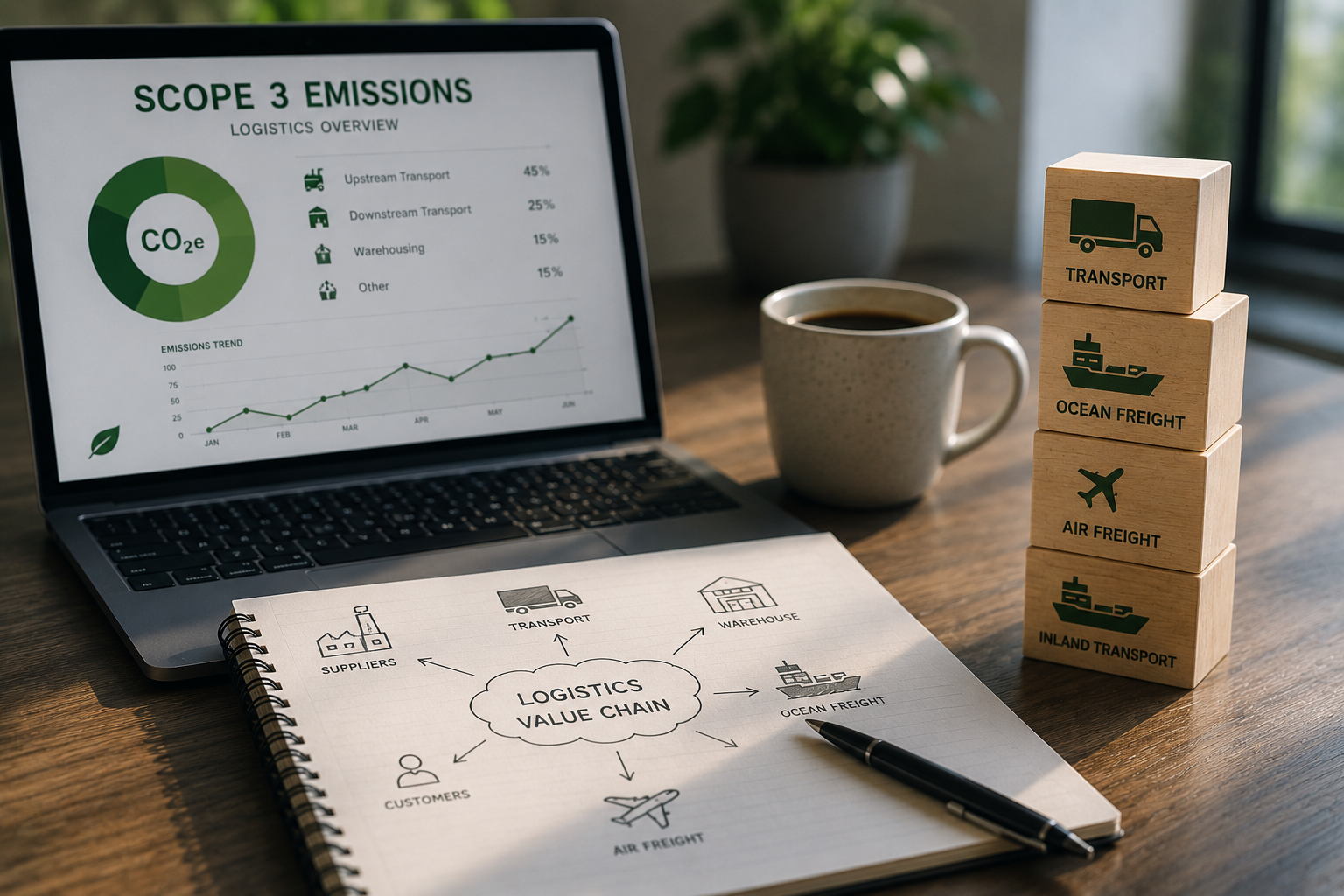
Scope 3 logistics emissions: a practical guide
For many companies, logistics emissions are one of the most complex parts of the climate footprint. Goods move across suppliers, warehouses, ports, terminals, carriers, freight forwarders and customers. Transport is often outsourced, data is spread across multiple systems and companies do not always control the fuel used in their supply chain.
That is exactly why Scope 3 logistics emissions matter. They are often outside a company’s direct operations, but they are still part of the value chain. For cargo owners, retailers, producers, freight forwarders and logistics platforms, reducing these emissions is becoming an essential part of credible climate action.
This guide explains what Scope 3 logistics emissions are, how companies can calculate them and which practical steps can reduce them across road, ocean freight, air freight and inland transport.
What are Scope 3 logistics emissions?
Scope 3 logistics emissions are the greenhouse gas emissions from transport and distribution activities that happen in a company’s value chain, but outside its direct operational control. This can include inbound transport from suppliers, outbound transport to customers, third party warehousing, distribution, freight forwarding and transport services purchased through logistics partners.
The GHG Protocol splits transport and distribution emissions across different Scope 3 categories. Category 4 covers upstream transportation and distribution, including transport services purchased by the reporting company. Category 9 covers downstream transportation and distribution after the point of sale, when these services are not purchased by the reporting company.
In practice, this means logistics emissions can sit in different places depending on who buys the transport service, who controls the goods and where the transport takes place in the value chain.
Why are Scope 3 logistics emissions difficult to manage?
Scope 3 logistics emissions are difficult to manage because transport chains are fragmented. A single product may move by truck, vessel, aircraft, barge and rail before reaching its final destination. Each step may involve a different logistics provider, carrier, subcontractor or data system.
Companies often face three practical challenges. First, emissions data is incomplete or inconsistent. Second, responsibility is shared across multiple parties. Third, sustainable fuel or low-emission transport options are not always available on the exact route where the company ships goods.
This makes logistics emissions different from energy use in an office or fuel use in a company-owned fleet. The company may be responsible for reporting and reducing emissions, while the physical transport activity is carried out by someone else.
Which Scope 3 categories include logistics emissions?
The most relevant Scope 3 categories for logistics emissions are usually Category 4: Upstream transportation and distribution and Category 9: Downstream transportation and distribution.
Category 4 typically includes inbound logistics, outbound logistics purchased by the company and transportation between a company’s own facilities when carried out by third parties. According to the GHG Protocol, purchased transportation and distribution services in the reporting year are included here, including inbound logistics, outbound logistics and transport between company facilities when those vehicles or facilities are not owned or controlled by the reporting company.
Category 9 applies to transportation and distribution after the point of sale, but only when the reporting company does not purchase the transport service. The GHG Protocol notes that outbound transportation services purchased by the reporting company are included in Category 4, not Category 9.
That distinction is important for accurate reporting. The same shipment can be accounted for differently depending on the commercial relationship and who pays for the transport.
How should companies calculate Scope 3 logistics emissions?
Companies should calculate Scope 3 logistics emissions using a consistent methodology that reflects the transport chain. The most relevant frameworks are the GHG Protocol, ISO 14083 and the GLEC Framework.
ISO 14083 establishes a common methodology for quantifying and reporting greenhouse gas emissions from transport chains for passengers and freight. The GLEC Framework, developed by Smart Freight Centre, is designed to harmonize logistics emissions calculation and reporting across multi-modal supply chains and supports implementation of ISO 14083.
A practical calculation usually starts with transport activity data, such as mode, distance, weight, shipment volume, fuel use or carrier emissions data. When primary data is not available, companies often use emission factors based on transport mode, fuel type and tonne-kilometres. Over time, the goal should be to move towards higher-quality primary data from carriers and logistics partners.
What logistics data do companies need for Scope 3 reporting?
The data needed depends on the transport mode, reporting method and level of accuracy. At minimum, companies usually need the transport mode, shipment weight or volume, origin and destination, distance, carrier or logistics provider, and reporting period.
For more accurate reporting, companies should also collect fuel type, vehicle or vessel type, load factor, empty running assumptions, temperature control, warehousing energy use and primary emissions data from logistics providers. For maritime transport, vessel data and fuel documentation can be relevant. For air freight, routing and cargo weight can have a significant impact.
Good data does not need to be perfect from day one. A practical approach is to start with the largest transport flows, identify the biggest data gaps and improve data quality step by step.
How can companies reduce Scope 3 logistics emissions?
Companies can reduce Scope 3 logistics emissions by combining operational improvements, modal shifts, carrier engagement and sustainable fuels. The right mix depends on the supply chain, transport mode and available infrastructure.
Operational measures include better load planning, route optimization, fewer empty kilometres, warehouse consolidation and improved forecasting. Modal shift can reduce emissions by moving freight from air to sea, road to rail or road to inland waterways where this fits the business. Carrier engagement helps companies select partners with cleaner fleets, better data and stronger decarbonization plans.
Sustainable fuels are especially important where emissions are hard to avoid. In road transport, HVO100 can reduce CO₂e emissions compared to fossil diesel. In ocean freight, sustainable marine biofuels can replace fossil marine fuels. In aviation and inland barging, sustainable fuel solutions can help reduce emissions where electrification or direct operational changes are not yet available at scale.
What role does transport insetting play in Scope 3 reduction?
Transport insetting means reducing emissions within the transport value chain itself. Instead of compensating emissions through projects outside logistics, companies support lower-emission transport solutions in the sector where the emissions occur.
This is especially relevant for Scope 3 logistics emissions. A cargo owner may not control the fuel used in a vessel, truck or aircraft, but can still support the use of sustainable fuels in the transport system. The resulting CO₂e reduction can then be allocated to the company’s value chain through a controlled methodology.
Transport insetting helps companies move from simply measuring logistics emissions to actively reducing them. It also creates demand for sustainable fuels, which helps accelerate the transition across freight transport.
How does Book & Claim help reduce Scope 3 logistics emissions?
Book & Claim is a practical model for logistics decarbonization when sustainable fuel is not physically available on a company’s exact route. The sustainable fuel is used where it can be deployed, while the environmental attribute is recorded in a digital registry and allocated to the buyer.
This is useful in global logistics because fuel supply and cargo ownership do not always line up. A company may have ocean freight emissions across many trade lanes, while sustainable marine fuel is only available in selected ports. Book & Claim makes it possible to support sustainable fuel use where it is available and claim the corresponding CO₂e reduction in a controlled and traceable way.
For Scope 3 reporting, the quality of the Book & Claim system matters. Each reduction should be unique, documented, allocated once and retired once. A digital registry and third party verification help prevent double counting and strengthen the credibility of the claim.
What is the difference between reducing and offsetting logistics emissions?
Reducing logistics emissions means cutting emissions within the transport value chain itself. This can happen through efficiency, modal shift, electrification, renewable energy or sustainable fuels. The impact is connected to the activity that causes the emissions.
Offsetting usually means compensating for emissions through projects outside the company’s value chain, such as forestry or carbon removal projects. Offsetting may have a role for residual emissions, but it is not the same as reducing transport emissions.
For companies with serious Scope 3 logistics targets, the priority should be to reduce emissions in the value chain wherever possible. Transport insetting and Book & Claim can support that by creating a direct link between corporate demand and sustainable fuel use in logistics.
How does SBTi influence Scope 3 logistics emissions?
The Science Based Targets initiative, SBTi, is important because many companies use it to set climate targets aligned with net zero. SBTi’s Corporate Net-Zero Standard provides guidance for companies setting science-based net-zero targets, and its Version 2.0 is designed to make climate action more practical and relevant for companies at different stages of the transition.
For logistics, this means companies need credible ways to reduce value chain emissions, not only calculate them. Scope 3 transport emissions are often material and difficult to address, so companies need practical mechanisms that combine real emissions reductions, transparent accounting and strong documentation.
SBTi reinforces the direction of travel: companies should understand their value chain emissions, set credible targets and move from ambition to implementation.
What should a Scope 3 logistics emissions plan include?
A practical Scope 3 logistics emissions plan should include five elements: measurement, prioritisation, reduction levers, documentation and governance.
Measurement creates the baseline. Prioritisation identifies the largest emissions sources, such as ocean freight, air freight, road transport or warehousing. Reduction levers define how the company will cut emissions, from efficiency and modal shift to sustainable fuels and transport insetting. Documentation ensures every claim is supported by data, certificates and traceability. Governance makes sure responsibilities, targets and progress reviews are embedded in the business.
The plan should be practical enough to start now and flexible enough to improve over time. The first version does not need perfect data. It needs clear boundaries, consistent methods and a credible path to better data and deeper reductions.
How can companies start reducing Scope 3 logistics emissions today?
Companies can start by mapping their main logistics flows and identifying where the largest emissions occur. For many businesses, the biggest opportunities will be in ocean freight, long-haul road transport, air freight or high-volume distribution networks.
The next step is to improve data quality with carriers and freight forwarders. After that, companies can select reduction actions: optimize shipments, consolidate loads, shift modes where possible and use sustainable fuels where operationally feasible.
Where sustainable fuels are not physically available on the company’s own route, Book & Claim and transport insetting can help. These solutions make it possible to support real fuel replacement in the transport sector and allocate the verified CO₂e reduction to the company’s Scope 3 footprint.
What is the key takeaway on Scope 3 logistics emissions?
Scope 3 logistics emissions are complex, but they are manageable. Companies do not need to wait for perfect data or full control over every shipment before taking action.
The practical route is to measure emissions consistently, focus on the largest transport flows, work closely with logistics partners and use credible reduction mechanisms. Sustainable fuels, Book & Claim and transport insetting can help companies reduce emissions in the transport value chain itself, even when direct physical fuel access is limited.
For companies with serious climate targets, logistics is no longer just a cost or service category. It is a strategic part of supply chain decarbonization. The companies that act early can build better data, stronger partnerships and more credible progress towards a cleaner transport system.
