
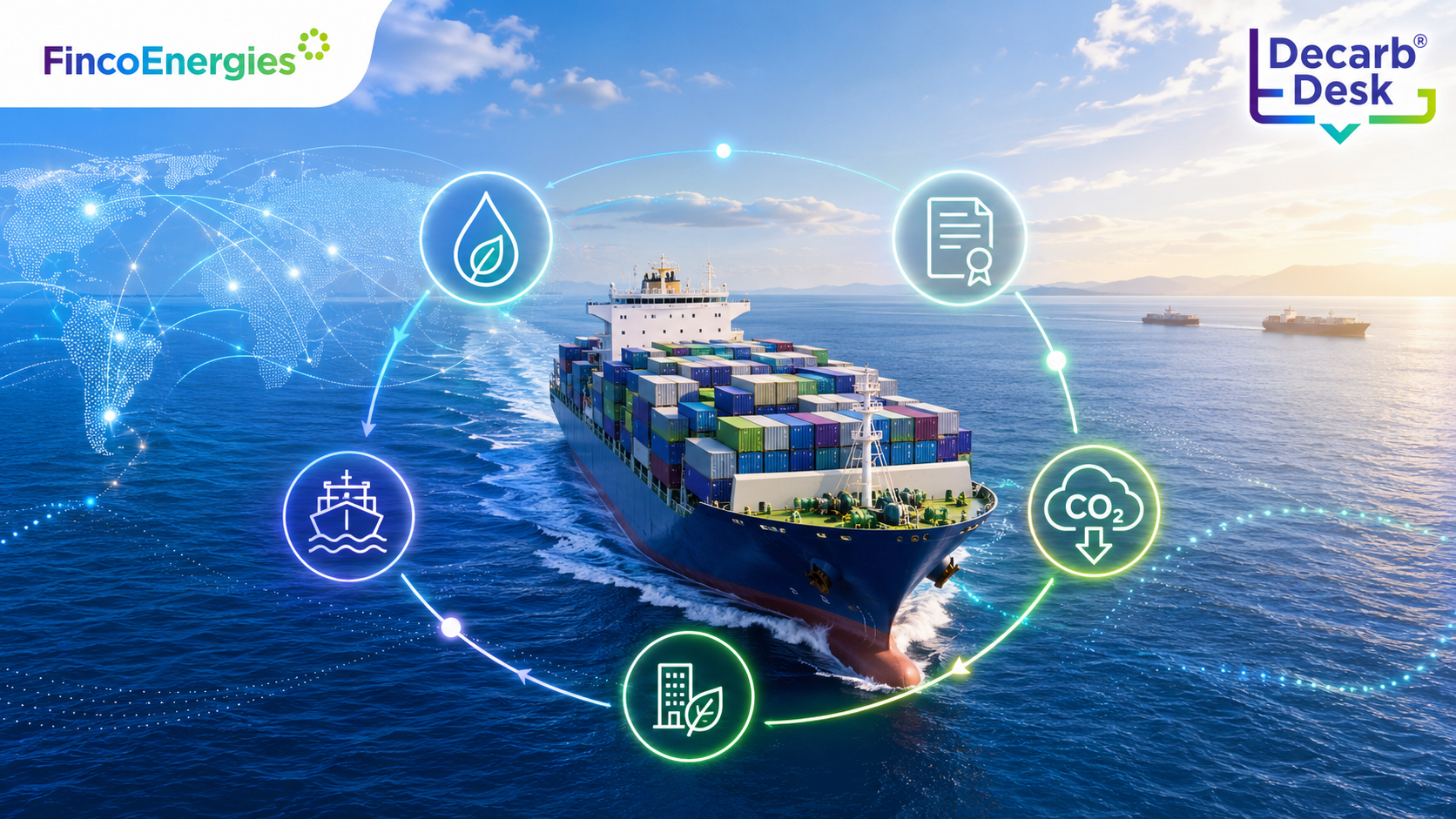
Scope 3 Ocean Freight Emissions: Why Waiting Isn’t a Decarbonization Strategy
For many companies, ocean freight is one of the largest contributors to Scope 3 emissions. Yet it is also one of the hardest sectors to decarbonize.
Supply chains are complex. Cargo moves on shared vessels, logistics providers are often selected by freight forwarders, and cargo owners rarely have influence over the fuel powering the ship transporting their goods.
Does that mean companies have to wait for the shipping industry to fully transition to low-carbon fuels? Absolutely not.
Decarbonize your shipments without changing your logistics network
At FincoEnergies, we believe sustainability shouldn’t require companies to redesign their supply chains.
Through our practical GoodShipping solution, businesses can reduce the carbon footprint of their ocean freight using a Book & Claim approach. Instead of requiring sustainable marine fuel to be bunkered onto the exact vessel carrying your cargo, verified fuel is supplied elsewhere in the global shipping network. The resulting emissions reductions are then allocated to your shipments through a transparent and independently verified chain of custody, developed in collaboration with the Smart Freight Centre and managed through our registry and digital platform, Decarb Desk®.
The result? Real climate impact without disrupting your existing logistics operations.
Why Book & Claim works for shipping
Unlike road transport, where fuel can often be supplied directly to a local trucking fleet, ocean shipping operates on a global scale. Cargo owners typically share vessels with hundreds of other companies and have little visibility into where or when fuel is bunkered.
Book & Claim removes these operational barriers. It allows sustainable marine fuels to be supplied where they are available while enabling cargo owners anywhere in the world to claim the associated emissions reductions for their own shipments. This creates demand for low-carbon fuels, accelerates their adoption and helps scale the transition of the maritime sector.
Environmental Attribute Certificates (EACs) for sustainable marine fuel make this allocation practical. Much like energy attribute certificates for renewable electricity, they separate the environmental attributes of lower-emission fuel use from the physical fuel itself. Your cargo does not need to travel on the vessel where the fuel is used for your company to support—and credibly account for—the resulting CO2e reduction.
Additional action, not business as usual
Not every environmental attribute certificate represents the same kind of action.
Some sustainable marine fuel use is mandated: it helps vessel owners meet fuel-intensity targets, blending obligations or other regulatory requirements. Certificates that are labelled as “additional” represent bio-fuel use that goes beyond the mandated blended fuel obligations. It is driven by voluntary demand from cargo owners that want to reduce their Scope 3 shipping emissions and help scale the market faster.
This distinction matters. A credible Scope 3 certificate should be linked to sustainable marine fuel use that goes beyond mandated requirements. Mandated and additional attributes must be tracked, allocated and claimed separately so the same reduction is not used both for regulatory compliance and for voluntary corporate action.
GoodShipping is built around this principle. The Scope 3 certificates allocated to cargo owners are connected to additional sustainable marine fuel use and supported by a digital Book & Claim methodology through Decarb Desk.
A practical solution for Scope 3
Whether you are a manufacturer, retailer or global brand, your logistics emissions remain part of your climate responsibility. With GoodShipping, FincoEnergies enables organizations to:
- Reduce Scope 3 emissions from ocean freight.
- Continue working with existing freight forwarders and shipping lines.
- Support additional demand for sustainable marine fuels.
- Receive transparent and audited documentation suitable for sustainability reporting.
- No operational changes, no new shipping contracts, no disruption to your supply chain!
From ambition to a verified certificate
Taking action can be straightforward, even for teams that do not procure fuel or control vessel operations.
- Define the ambition
Quantify the maritime transport emissions in your ocean freight and decide what level of Scope 3 reduction you want to achieve. This can be based on shipment data, trade lanes, annual freight volumes or a specific reporting period.
- Choose the sustainable marine fuel solution
Select the relevant GoodShipping solution, for instance based on feedstock and vessel type. Sustainable marine fuel is then used in shipping, creating a real CO2e reduction compared with conventional fossil marine fuel.
- Allocate the reduction through Book & Claim
Decarb Desk digitally registers the environmental attributes linked to that fuel use and allocates them to the cargo owner. The methodology follows the Smart Freight Centre Market Based Measures Framework, supporting market-based accounting for logistics emissions and flexible chain-of-custody models such as Book & Claim.
- Receive verified documentation
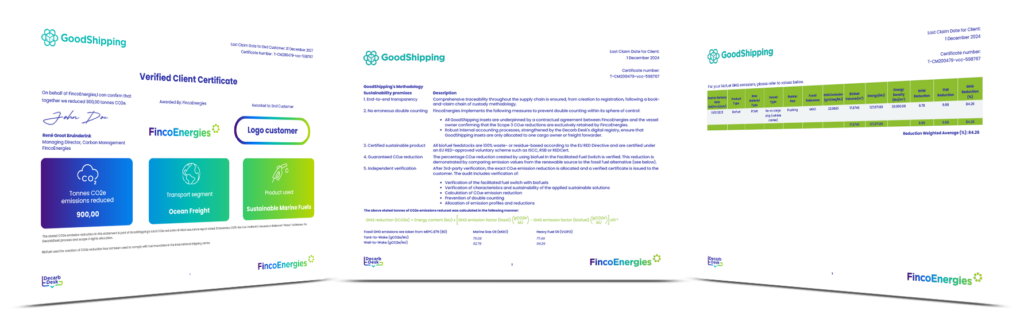
The cargo owner receives a verified customer certificate with traceability information. This provides clear evidence of the allocated CO2e reduction and supports internal reporting, audit and external disclosure.
Backed by transparency
Credibility is essential when making climate claims. Every GoodShipping transaction is supported by robust documentation and an independently verified allocation process. Customers receive clear evidence of the sustainable fuel supplied and the corresponding emissions reductions allocated to their shipments.
The GHG Protocol provides the foundation for measuring and reporting Scope 3 transport emissions, while guidance for actions and market instruments continues to develop. SBTi sets expectations for corporate climate targets and now recognizes the usage of the GoodShipping methodology as a practical solution (a market instrument) for companies to meet their scope 3 targets in hard-to-abate sectors such as transport.
Should companies wait for every standard to be finalized before acting? We don’t think so. Action today can be credible when it is transparent, additional, traceable and supported by a robust methodology.
FincoEnergies makes the complex practical
As the market for sustainable marine fuels develops, execution and clarity are critical. Cargo owners need to know what they are buying, how the reduction is created and how it can be used in reporting. FincoEnergies supports cargo owners across the full process:
- Identify the right starting point based on their maritime transport footprint.
- Define a practical emissions-reduction ambition.
- Supply sustainable marine fuel solutions through GoodShipping.
- Allocate additional Scope 3 certificates through Decarb Desk®.
- Provide verified, audit-ready documentation with clear traceability.
Through GoodShipping, FincoEnergies acts as a bridge between a complex fuel transition and a practical solution for cargo owners. The vessel does not need to change route. The cargo does not need to move differently. The company does need to make a clear choice: support additional sustainable marine fuel use and claim the verified CO2e reduction through a credible Book & Claim process.
Turning ambition into action
The maritime sector is undergoing one of the largest transformations in its history. Regulations are tightening, customer expectations are increasing and businesses are setting increasingly ambitious climate targets. But waiting for every vessel to run on sustainable fuels is not a realistic strategy. Companies can already take meaningful action today.
By supporting additional sustainable marine fuel use through FincoEnergies’ GoodShipping, businesses can reduce the climate impact of their ocean freight, contribute to scaling the market for low-carbon shipping fuels and make measurable progress towards their Scope 3 targets.
Because decarbonization isn’t just about changing ships—it’s about changing how we work together to fuel the future.
