
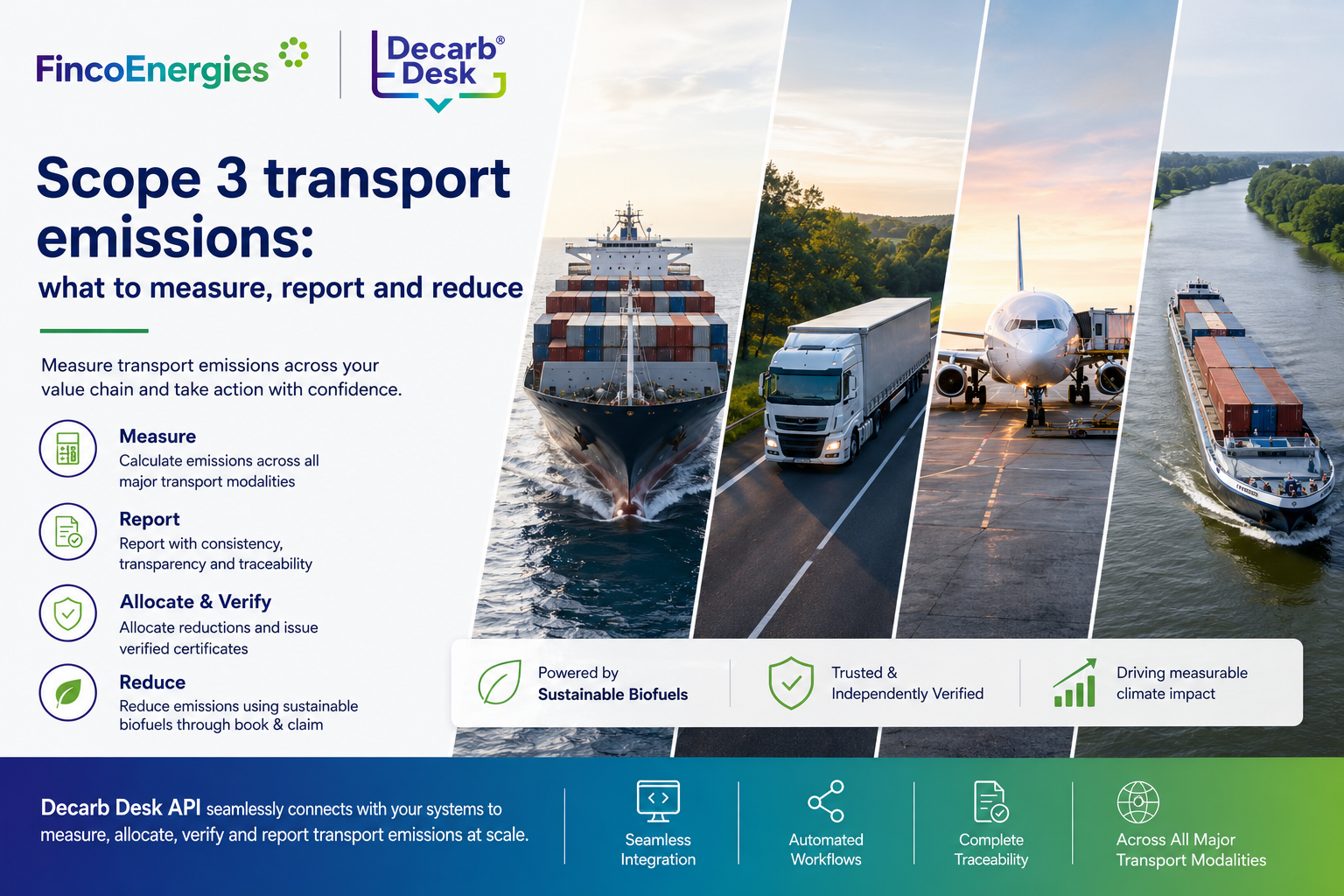
Transport is one of the most visible parts of a company’s value chain. Goods move from suppliers to warehouses, from production sites to customers, across oceans, over roads, through inland waterways and by air. Every movement has an emissions impact. For many companies, a large share of that impact sits outside their direct operations, in Scope 3.
That makes Scope 3 transport emissions both a reporting challenge and a practical opportunity. The data can be complex, but the direction is clear. Measure the movements that matter. Report them in a consistent way. Then reduce them with solutions that create real change within the transport chain.
At FincoEnergies, Decarb Desk® turns that ambition into action. Decarb Desk® is our platform for calculating transport emissions, allocating reductions and managing certificates in a transparent, traceable way. Through a digital book & claim methodology, companies can reduce Scope 3 transport emissions across all major transport modalities, including ocean, road, air and inland waterway transport.
What are Scope 3 transport emissions?
Scope 3 transport emissions are indirect greenhouse gas emissions from transport activities in a company’s value chain. They are not produced by assets that the company owns or controls, and they are not linked to purchased electricity. Instead, they come from activities such as outsourced road freight, ocean shipping, air freight, inland waterway transport, warehousing, distribution and delivery.
In the Greenhouse Gas Protocol, transport emissions mainly appear in two Scope 3 categories:
- Category 4: Upstream transportation and distribution. This includes transport and distribution services purchased by the reporting company, such as inbound logistics, outbound logistics paid for by the company and transport between company sites when operated by third parties.
- Category 9: Downstream transportation and distribution. This includes transportation and distribution of sold products after the point of sale, when the reporting company does not pay for or control that transport service.
The difference is important. Scope 3 transport reporting is not only about where goods move. It is also about who purchases the transport service, where ownership changes and how the transport activity fits into the value chain.
Why Scope 3 transport emissions matter for companies?
Scope 3 is often the largest part of a company’s total carbon footprint. For cargo owners, retailers, manufacturers and brands with international supply chains, freight can be a significant contributor.
That is why transport emissions matter for more than sustainability reporting. They influence procurement decisions, supplier engagement, customer expectations, CSRD readiness and climate target progress.
Companies that understand their transport emissions can answer essential questions:
- Which lanes create the highest emissions impact?
- Which transport modes carry the highest carbon intensity?
- Which logistics partners provide reliable emissions data?
- Where can emissions be reduced without disrupting the supply chain?
- Which reductions can be credibly reported against Scope 3 targets?
- How can reductions be allocated transparently across different freight modalities?
A strong transport emissions approach gives companies more control. It helps sustainability, logistics, finance and procurement teams work from the same facts and move towards the same goal.
What should companies measure for Scope 3 transport emissions?
To measure Scope 3 transport emissions, companies need more than total spend on logistics. Spend based estimates can be useful for a first screening, but real progress starts with activity data.
The most useful data points include:
- Shipment origin and destination
- Transport mode, such as ocean, road, rail, inland waterway or air
- Weight or volume of goods transported
- Distance travelled
- Carrier or logistics provider
- Fuel type, where available
- Load factor, where available
- Temperature controlled transport, where relevant
- Warehousing or hub activity, where included in the boundary
- Empty running assumptions, where relevant
- Emission factor source and calculation method
The more specific the data, the stronger the footprint. A tonne kilometre based calculation is usually more meaningful than a spend based calculation, because it reflects how much freight moved and how far it travelled.
The goal is not perfection from day one. The goal is a reporting model that becomes more accurate over time. Start with the most material transport flows, document the assumptions and improve data quality with each reporting cycle.
How to report Scope 3 transport emissions?
Scope 3 transport emissions should be reported in a way that is transparent, consistent and traceable. Companies need to show what is included, which methodology was used, what data quality level was achieved and where estimates were applied.
A strong report includes:
- The Scope 3 categories covered
- The reporting boundary
- Transport modes included
- Calculation methodology
- Emission factors used
- Data sources and assumptions
- Total emissions in CO₂e
- Any exclusions and the reason for them
- Progress compared with the base year
- Actions taken to reduce emissions
- Certificates or evidence linked to reduction claims
For companies reporting under CSRD and ESRS, Scope 3 becomes part of a broader climate disclosure. That makes the quality of the data and the clarity of the method even more important. Reporting is moving from a voluntary sustainability exercise to a business process that needs structure, ownership and assurance readiness.
Decarb Desk® supports that shift by bringing emissions calculation, reduction allocation and certificate management into one digital workflow. That helps companies move from fragmented data to a more transparent and verifiable approach.
Scope 3 Category 4: upstream transportation and distribution
Scope 3 Category 4 covers transport and distribution services purchased by the reporting company. This often includes inbound freight from suppliers, outbound freight to customers when paid for by the company, and third party transport between company locations.
For many companies, Category 4 is the main Scope 3 transport category because the company has a direct commercial relationship with the carrier, freight forwarder or logistics service provider. That creates a clear opportunity to request better data, align on methodology and include emissions performance in procurement decisions.
Category 4 is also where carbon insetting can play a powerful role. When a company purchases freight services, it can support the use of lower emission transport services and allocate the resulting emissions reduction to its Scope 3 transport footprint through a transparent book & claim process.
Scope 3 Category 9: downstream transportation and distribution
Scope 3 Category 9 covers transportation and distribution after the point of sale, when the reporting company does not purchase the transport service. This can include customer arranged delivery, downstream distribution networks or retail logistics beyond the company’s control.
Category 9 can be harder to measure because data often sits with customers, distributors or third party partners. Still, it matters. Companies can improve Category 9 reporting by mapping downstream flows, engaging customers and distributors, using product volumes and transport assumptions, and improving estimates over time.
Even when control is limited, influence is possible. Better data sharing, smarter distribution models and low carbon transport options can help reduce downstream emissions in a credible way.
How to reduce Scope 3 transport emissions?
Measurement creates insight. Reduction creates impact. Companies can reduce Scope 3 transport emissions through a combination of efficiency, modal choices, collaboration and fuel switching.
Practical reduction actions include:
- Optimising routes and shipment planning
- Increasing load factors
- Reducing empty kilometres
- Shifting from air to ocean, rail or road where possible
- Consolidating shipments
- Choosing logistics partners with strong emissions performance
- Using lower emission fuels
- Applying carbon insetting for transport activities that are difficult to directly control
- Managing reductions through a digital book & claim platform
Each action has a different level of effort, speed and impact. Efficiency improvements are valuable, but they do not always address the fuel used in transport. That is why fuel switching and market based transport decarbonisation solutions are essential for deeper reductions.
How Decarb Desk helps reduce Scope 3 transport emissions?
Decarb Desk is FincoEnergies’ platform for supply chain decarbonisation. It helps companies calculate transport emissions, access carbon insetting solutions, allocate CO₂e reductions and manage certificates with full traceability.
The platform is designed for companies that want to reduce Scope 3 transport emissions across multiple freight modalities. Instead of managing separate processes for ocean, road, air and inland waterway transport, companies can work from one integrated environment.
Decarb Desk® enables companies to:
- Calculate and manage transport emissions
- Access FincoEnergies’ carbon insetting portfolio
- Allocate CO₂e reductions through a digital book & claim methodology
- Receive traceable certificates
- Support independent verification of sustainability claims
- Connect existing systems through API integration
This creates a clear route from data to action. Companies can understand their transport footprint, choose the right reduction solution and receive documentation that supports credible reporting.
What is digital book & claim for transport emissions?
Digital book & claim is a chain of custody model that separates the environmental benefit from the physical transport activity, while keeping the allocation transparent and traceable.
In practice, this means a company can support the use of lower emission transport services, even when its own goods are not physically moved on the specific vehicle, vessel or aircraft using the lower emission solution. The environmental benefit is booked, verified and claimed through a controlled registry.
This approach matters because freight networks are complex. A cargo owner may not control the exact fuel used on a specific route. Infrastructure availability can vary by location. Logistics decisions are often managed by several parties. Book & claim helps overcome these barriers by allowing companies to contribute to real decarbonisation activity within the transport sector and claim the associated reduction in a structured way.
With Decarb Desk, this process is managed digitally. Reductions are allocated through a transparent book & claim register, certificates are managed in one environment and claims can be supported with traceable documentation.
Why multimodal carbon insetting matters?
Supply chains rarely rely on one transport mode. A single product can move by ocean vessel, truck, inland barge and sometimes air freight before it reaches its final destination. A credible Scope 3 strategy needs to reflect that reality.
That is why multimodal carbon insetting matters. Companies need solutions that work across the transport chain, not only within one segment of it.
Decarb Desk gives companies access to carbon insetting solutions across all major transport modalities:
- Ocean transport
- Road transport
- Air freight
- Inland waterway transport
This multimodal approach helps sustainability and logistics teams manage reductions more efficiently. It also makes it easier to align transport decarbonisation with procurement, reporting and customer requirements.
What makes a Scope 3 transport reduction credible?
Credibility is essential. Companies need reductions that can stand up to internal review, external reporting and stakeholder scrutiny.
A credible transport reduction should be:
- Linked to real decarbonisation activity
- Based on a clear methodology
- Calculated with reliable emission factors
- Allocated only once
- Supported by evidence of the fuel switch or reduction activity
- Traceable through documentation
- Aligned with recognised accounting principles
- Suitable for reporting in the relevant Scope 3 category
This is why verification, allocation and registry based documentation matter. The climate benefit must be real, measurable and connected to the transport system. Good data builds trust. Clear documentation turns ambition into reportable progress.
Scope 3 transport emissions checklist for companies
Companies that want to improve their Scope 3 transport reporting can start with a focused checklist:
- Map your main inbound, outbound and downstream transport flows
- Identify which flows belong in Category 4 and which belong in Category 9
- Collect activity data from logistics providers and internal systems
- Choose a recognised calculation methodology
- Record emission factors, assumptions and exclusions
- Prioritise the highest impact routes and modes
- Engage procurement and logistics teams early
- Set reduction actions linked to real transport decisions
- Explore carbon insetting for emissions that are hard to reduce directly
- Use a digital book & claim platform to manage allocation and certificates
- Keep improving data quality each year
This approach helps companies move from estimated footprints to actionable transition plans.
Frequently asked questions about Scope 3 transport emissions
Are freight emissions Scope 3?
Freight emissions are Scope 3 when the transport is carried out by a third party and the vehicles, vessels or aircraft are not owned or controlled by the reporting company. If the company owns or controls the transport assets, the emissions may fall under Scope 1 or Scope 2, depending on the energy source.
What is the difference between Scope 3 Category 4 and Category 9?
Category 4 covers transport and distribution services purchased by the reporting company. Category 9 covers transportation and distribution after the point of sale when the reporting company does not purchase the transport service. The distinction depends on the value chain boundary and who pays for or controls the transport service.
What data do you need to calculate transport emissions?
The most useful data includes origin, destination, distance, transport mode, shipment weight, carrier, fuel type and emission factor. Where exact data is not available, companies can use documented assumptions and improve the calculation over time.
Can book & claim reduce Scope 3 transport emissions?
Yes. Book & claim can support Scope 3 transport reductions when it is linked to real low emission transport activity, managed through a transparent registry and supported by traceable documentation. It allows companies to contribute to transport decarbonisation and claim the allocated reduction, even when the lower emission service is not physically tied to their exact shipment.
Which transport modalities can Decarb Desk support?
Decarb Desk supports carbon insetting across all major transport modalities, including ocean, road, air and inland waterway transport. This helps companies manage reductions across complex supply chains through one integrated platform.
How can companies start reducing Scope 3 transport emissions?
Start by measuring the most material transport flows, then identify where action is possible. Optimise logistics, work with carriers, improve data quality and use carbon insetting to support lower emission transport services. With Decarb Desk, companies can calculate, allocate, verify and report reductions through one digital workflow.
From transport data to transport decarbonisation
Scope 3 transport emissions are now part of how companies understand risk, build resilience and show progress on climate goals.
The path forward is practical. Measure the movements that matter. Report them with confidence. Reduce them through real action in the transport chain.
With Decarb Desk ®, FincoEnergies helps companies turn freight emissions into a clear decarbonisation opportunity. The platform brings calculation, allocation, certification and traceability together across all major transport modalities. That gives companies a practical way to reduce Scope 3 transport emissions today and accelerate cleaner freight for the future.